


Lip Filler Migration: Why It Happens and How It Can Be Corrected


Why does lip filler that looked perfectly defined months ago suddenly appear to be shifting toward your nose? This phenomenon, known as lip filler migration, occurs when the hyaluronic acid gel moves away from its intended anatomical plane, often blurring the sharp vermilion border and creating an unnatural shelf or shadow above the lip. It's a clinical complication that can be deeply distressing, especially when you've invested in your appearance to feel more confident, not less.
You might feel that your only options are to wait years for the product to degrade naturally or to add even more filler to balance the shape. However, neither approach addresses the underlying displacement. In our Kuala Lumpur practice, we view correction as a precise medical necessity rather than a simple aesthetic redo. By understanding the specific causes, such as improper product rheology or incorrect injection depth, you can make informed decisions about your restorative journey.
This guide explains the professional protocols Dr. Renee and Dr. Cheok use to restore natural lip contours. We'll explore the science of medical-grade hyaluronidase, how to identify an injector with the requisite anatomical expertise, and the exact timeline you can expect for a full restoration of your features. You'll gain the clarity needed to move from anxiety about facial distortion to a structured plan for a subtle, organic-looking outcome.
Table of Contents
Identifying Lip Filler Migration: Recognizing the 'Filler Moustache'
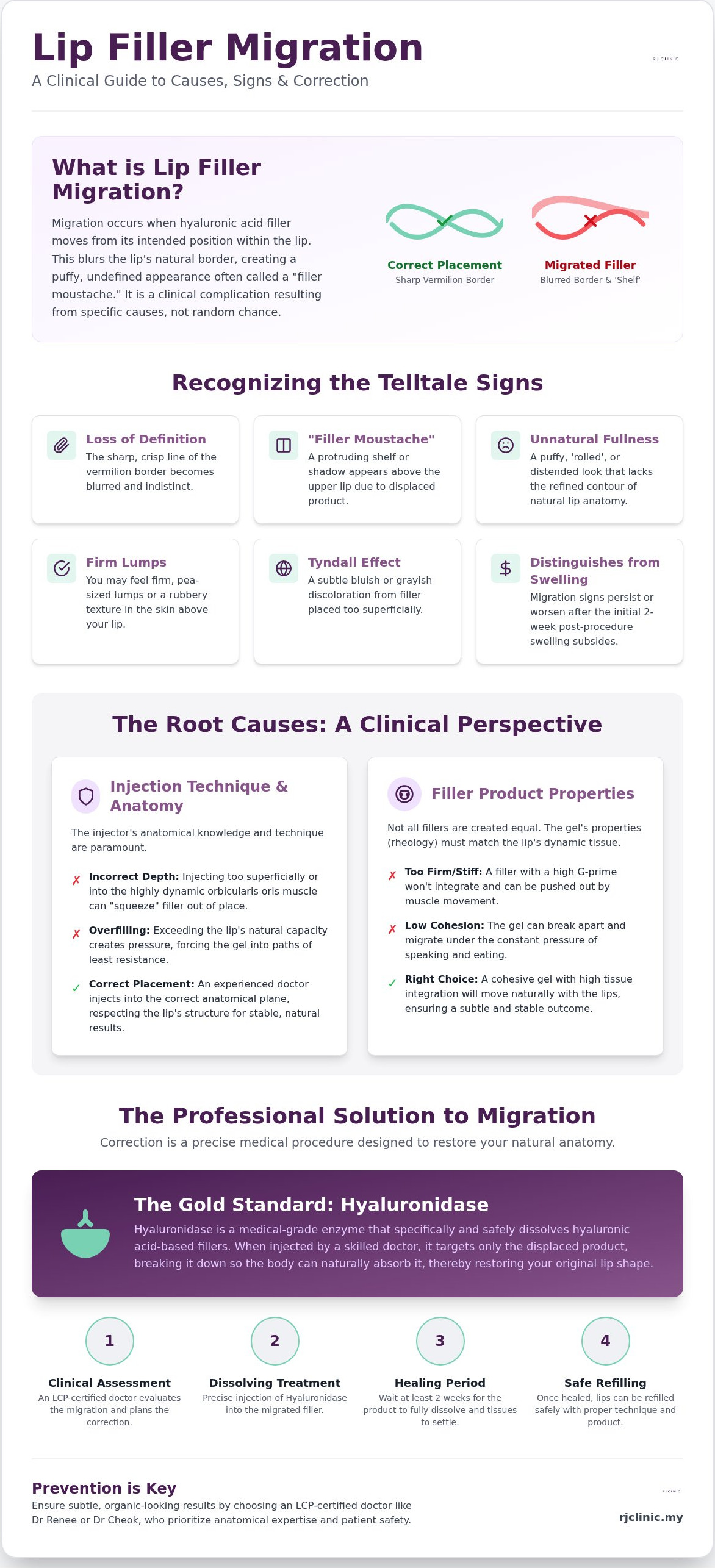
Clinical observation shows that lip filler migration rarely happens overnight. It's often a subtle, progressive shift where the product moves from the vermilion body into the cutaneous portion of the upper lip. One of the most telling signs is the loss of a crisp, defined vermilion border. When the filler displaces, the sharp line that separates your lip from the surrounding skin becomes blurred, leading to a puffy or "rolled" appearance that lacks the refined contour of natural anatomy.
This displacement often creates what is colloquially known as a "filler moustache." This isn't actual hair, but a shadow cast by a protruding shelf of product sitting just above the lip line. To understand why this happens, it helps to revisit the basics of What Are Lip Fillers? and how they interact with soft tissue. When lip filler is placed incorrectly, it can create a physical ridge that catches the light, resulting in an unnatural shadow that persists regardless of your facial expression. You might also feel firm, pea-sized lumps or a general rubbery texture when pressing the area above your lip, indicating that product has settled where it doesn't belong.
The Anatomical Signs of Displacement
True migration must be distinguished from the initial post-procedure swelling, which typically subsides within two weeks. If the fullness above your lip remains or worsens after this period, the product may have entered the orbicularis oris muscle. This muscle is highly dynamic; every time you speak, eat, or smile, the muscle's movement can "squeeze" poorly placed filler further away from the lip body. We often ask patients to perform specific facial animations during a consultation, as certain movements can reveal hidden filler shifts that aren't visible when the face is at rest.
The Tyndall Effect and Discoloration
In some cases, migrated filler presents as a subtle bluish or grayish tint in the skin above the lip. This is known as the Tyndall effect. It occurs when hyaluronic acid is injected too superficially or migrates into the upper layers of the dermis, where it scatters light differently than the surrounding tissue. While it can be mistaken for a bruise or pigmentation, a clinical assessment by Dr Renee or Dr Cheok can confirm if the discoloration is actually misplaced gel. Unlike a bruise, this tint won't fade with time and requires a targeted medical intervention to resolve the underlying cause.
Why Fillers Move: The Science of Rheology and Anatomy
Lip filler migration isn't just a matter of "bad luck"; it's often a direct result of product rheology, which refers to how a gel deforms and flows under pressure. In the dynamic environment of the mouth, we use our lips thousands of times a day to speak and eat. If a filler has a high G-prime, meaning it is too firm or stiff, it won't move naturally with your tissues. Instead, the constant mechanical stress of facial movement can physically push this rigid gel out of the lip body and into the surrounding skin.
Anatomy also plays a decisive role. The lip is divided into distinct planes, and injecting into the "wet-dry" mucosal border or too close to the surface increases the risk of displacement. When too much product is concentrated in one area, known as a bolus, it can create a path of least resistance for the gel to travel upward. Over time, the hydrophilic nature of hyaluronic acid, its tendency to attract water, can exacerbate this by causing the migrated product to swell. This leads to "overfilled syndrome," where the lips lose all natural proportion and the surrounding skin appears unnaturally distended.
Product Selection and Tissue Integration
Choosing the right gel is a clinical art. Cohesive hyaluronic acid gels are designed to stick together and integrate seamlessly with your lip tissue, whereas non-cohesive gels may break apart and migrate under pressure. At our practice, Dr Renee and Dr Cheok prioritize products with high tissue integration to ensure subtle, organic-looking outcomes. If you are concerned about your current results, a consultation for dermal fillers can help determine if the product used was suitable for your specific anatomy.
Injection Technique Faults
Technique is just as critical as the product itself. While linear threading is a common method, placing large volumes in the lip border often results in the product sitting too superficially. Tenting techniques, when performed correctly, can provide definition without the same lip filler migration risk. Deep placement within the proper anatomical plane is essential for stability. If an injector places product too high in the vermilion border, it acts like a wedge, eventually forcing the filler to shift toward the cutaneous lip and creating that unwanted "shelf" appearance. This is why we advocate for a conservative, layered approach to volume rather than aggressive, high-volume sessions.
Correction Protocols: The RJ Clinic Approach to Dissolving
Fixing lip filler migration requires a methodical clinical approach rather than a quick fix. When you visit us for a correction, Dr Renee or Dr Cheok will first perform a palpation and visual assessment to map out exactly where the product has settled. This step is vital because we need to determine the density and volume of the migrated gel to calculate the precise dosage of Hyaluronidase required. We don't believe in a one-size-fits-all injection; every correction is tailored to the specific depth and spread of the displaced product.
Hyaluronidase is a prescription-only enzyme that specifically breaks down hyaluronic acid. Once injected, it begins to dissolve the synthetic gel almost immediately. However, you should be prepared for a temporary "deflation" effect. As the migrated product disappears, your lips may look smaller or more wrinkled than you remember. This is a normal part of the restorative process. It's simply your natural anatomy returning to its baseline state before we begin a fresh, anatomically correct enhancement.
The 'Dissolve and Refill' Standard
One of the most common mistakes in aesthetic medicine is attempting to "top up" migrated lips to hide the distortion. This only adds more weight to the area, further stretching the tissue and worsening the displacement. At our clinic, we adhere to a strict 14-day rule. We require a minimum of two weeks between the dissolving session and any new injections. This period allows the enzyme to fully dissipate and the soft tissues to settle, ensuring that any new Safe Dermal Filler Procedures we perform are not compromised by residual dissolver.
Managing the Dissolving Process
While the procedure is straightforward, some temporary bruising or localized swelling is possible. A frequent concern is whether the enzyme will destroy your natural collagen or hyaluronic acid. While Hyaluronidase can interact with your body's own HA, the effect is transient; your body naturally replenishes its own hyaluronic acid within 24 to 48 hours. Our focus remains on precision, targeting only the areas of migration to preserve your natural tissue integrity. If you're experiencing signs of displacement, we recommend scheduling a clinical assessment for lip filler correction to discuss a tailored plan for restoration.
Preventing Future Migration: Medical Standards in Malaysia
Avoiding lip filler migration begins with a shift in perspective; viewing aesthetic enhancement as a medical procedure rather than a beauty commodity. In Malaysia, the regulatory framework is designed to protect patients through the Letter of Credentialing and Privileging (LCP). Choosing a doctor who holds this certification ensures they have the anatomical knowledge and clinical experience to handle complex soft tissue injections. While budget packages at beauty salons may seem attractive, they often lack medical oversight and use products not registered with the National Pharmaceutical Regulatory Agency (NPRA), significantly increasing the risk of long-term displacement.
The true cost of "budget" filler is often hidden in the corrective work required later. When low-quality products or improper techniques are used, the gel is more likely to lose its structural integrity and shift. We frequently see cases where patients have spent more on dissolving and correcting migrated filler than they would have on an initial, high-quality treatment. Investing in a medical-grade procedure from the start is the most effective way to ensure your results remain stable and within the natural lip body.
Choosing an LCP-Certified Practitioner
At our clinic, Dr Renee and Dr Cheok approach every case with a focus on structural integrity. We understand that the lips are a high-movement area where precision is non-negotiable. A medical clinic environment provides the safety standards necessary to minimize complications; this includes the use of sterile techniques and high-quality, cohesive gels. This same level of medical rigor applies across all our services, including V-Shape Face Contouring in KL, where we prioritize the balance of your unique facial features over aggressive volume.
Long-term Lip Health and Maintenance
Once you've achieved a successful correction, the goal is to maintain those results through conservative, well-timed treatments. Overfilling is the most common precursor to migration. When the skin and muscle are stretched beyond their natural capacity, the filler has nowhere to go but into the surrounding tissue. We recommend a "less is more" philosophy, utilizing smaller volumes of high-integration gel to build shape gradually over multiple sessions. For those seeking Professional Lip Augmentation, a customized multi-year plan is essential. This approach prevents the premature aging of the lip tissue and ensures that your results remain subtle and organic. In the days following your treatment, it's also critical to avoid heavy pressure or massage in the area; let the product settle into the correct anatomical plane as intended by your doctor.
Restoring Your Natural Lip Profile
Reclaiming your natural profile begins with identifying the blurred borders or characteristic shadow of lip filler migration. We've explored how product selection and precise anatomical placement are the foundations of stability; when these are compromised, correction becomes a medical necessity rather than a simple aesthetic choice. By utilizing FDA-approved dissolving protocols, we can safely clear displaced gel and reset the soft tissue for a more balanced, refined outcome.
At RJ Clinic, our LCP-certified practitioners, Dr. Renee and Dr. Cheok, specialize in managing these complex filler corrections with a focus on long-term tissue health. We prioritize a meticulous clinical assessment to ensure that any corrective treatment respects your unique facial structure and restores your confidence. If you're concerned about a "shelf" appearance or loss of definition, you don't have to settle for distorted results. To discuss a tailored plan for restoration, consult our LCP-certified doctors for a lip assessment. We're here to help you achieve a subtle, organic-looking result through a safe and structured clinical partnership.
Common Questions Regarding Lip Filler Correction
Can lip filler migration happen years later?
Lip filler migration can indeed manifest years after the initial injection. While hyaluronic acid is biodegradable, some high-density gels or overfilled areas don't break down as quickly as expected. The constant muscle activity of the mouth can gradually push these persistent fragments into the cutaneous lip. This is why we often see patients in our Bangsar or Mont Kiara clinics who only notice a "filler moustache" long after their last treatment.
Will my lips look wrinkled after dissolving migrated filler?
Your lips might appear temporarily deflated or slightly more wrinkled immediately after the dissolving procedure. This happens because the migrated filler that was stretching the tissue has been removed. However, this is a transient phase. Your body naturally begins to replenish its own hyaluronic acid within 24 to 48 hours. The skin's elasticity generally allows the tissue to settle back into its natural, healthy state before any future refinements.
Is it possible to massage migrated lip filler back into place?
Attempting to massage migrated filler back into its original position is not recommended and is often counterproductive. Manual pressure can actually force the gel deeper into the orbicularis oris muscle or spread it further into the surrounding tissue. In a clinical setting, Dr Renee and Dr Cheok use targeted Hyaluronidase injections because migration is a biological displacement that requires a chemical resolution, not physical manipulation which risks causing localized bruising or inflammation.
How much does it cost to fix migrated lip filler in Malaysia?
The cost for corrective treatment in Malaysia varies based on the volume of product to be dissolved and the complexity of the case. Because Hyaluronidase is a prescription-only enzyme, a formal medical assessment is required to determine the necessary dosage. Factors such as the brand of the original filler and how far it has shifted will influence the treatment plan. We provide a detailed breakdown during your clinical consultation at our Kuala Lumpur locations.
How many sessions of Hyaluronidase are typically needed?
Most patients require one to two sessions of Hyaluronidase to fully resolve the issue. The exact number depends on the rheology of the migrated product; some highly cross-linked fillers are more resistant to the enzyme and may need a secondary follow-up. We typically schedule a review one week after the first session to ensure the area is clear of all displaced gel before discussing any further aesthetic enhancements for the lips.
Can I get new lip filler immediately after the old one is dissolved?
We strictly observe a 14-day waiting period before performing any new injections after a dissolving session. This two-week window is essential for two reasons: it ensures the Hyaluronidase has completely left your system and it allows the internal tissue inflammation to subside. Injecting too soon risks the new filler being dissolved by residual enzyme, which would compromise your results and lead to an uneven, unsatisfactory outcome.


Comments